A knowledge database exists to provide users with appropriate knowledge. It is necessary to evaluate whether it is providing users with appropriate knowledge. For the evaluation of knowledge data (offline evaluation), a set of pairs of queries and results related to those queries (search results that should be returned for those queries) is prepared, and search accuracy is calculated using it.
Basic indicators in offline evaluation of search systems are recall and precision. A high recall state means that records related to the request are included in the search results without omission. A high precision state means that only records related to the request are included in the search results. Recall and precision can be calculated using the following formulas.
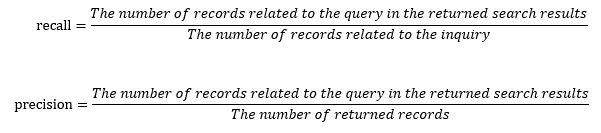
Recall and precision are indicators that well represent whether necessary data is included or unnecessary data is not included. However, there are the following challenges in directly using recall and precision for evaluating knowledge data retrieval.
Difficulty in defining query-related results
When the same knowledge is contained in multiple records, returning even one record as a search result satisfies the user's request. Therefore, it is impossible to define a single set of search results that should be returned for that query.
High cost of preparing query-related results
Strictly defining query-related results requires determining whether each record in the database is related to the query or not.
To address the first issue, instead of defining the correct set of records to be returned, there is a method to define it by the content and meaning of the data. For example, there is a method to evaluate whether the sentences included in the records support the expected claim.
The preparation cost for the correct answer, which is the second issue, can also be reduced by the above approach. This is because the definition of the correct answer can be made from the content of the query or the content of the correct answer to the query, rather than from (all) records included in the database.
"Judging based on the content of the text" refers to things like the following.
When the statement "Mount Fuji is the highest peak in Japan" is considered correct, if a record contains the sentence "Mount Fuji is 3776 meters high and is recorded as the tallest mountain in Japan", this sentence can be judged to support the correct fact.
In the method of judging based on the content and meaning of the text, it is necessary to extract the statement of fact from the query or correct content and determine whether these statements are included in the search results. While it is certainly possible for humans to perform this task, there is also a method to have language models do it. By doing so, the preparation cost for correctness can be further reduced.
When adopting a method to evaluate search accuracy based on the content included in the records, it is important to note that the evaluated target is not only the implementation method of the search process. This method is a direct evaluation approach of the content obtained as search results. Therefore, not only the search method of the database but also what kind of knowledge is included in the database and how the user converts the content they want to know into queries for the database will affect the evaluation. When evaluating the accuracy of search methods with this approach, it is necessary to identify which part is causing the issue before starting to tune the search method.
There are various metrics to represent search accuracy, but many calculations of search accuracy consist of two steps: obtaining evaluation values for individual records obtained as search results, and calculating search accuracy using the overall evaluation values of individual records (text chunks).
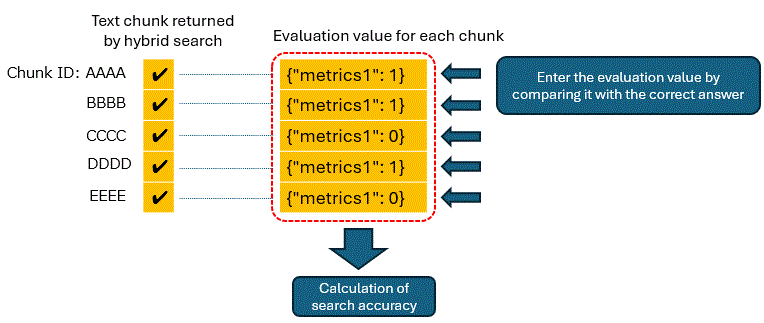
The search accuracy of subqueries can be calculated in the same way. The search accuracy can be evaluated in the same way for both full-text search subqueries and semantic text search. However, the text chunks returned by subqueries and the final hybrid search contain the same ones. Since the evaluation values for the same text chunks are common, these evaluation values can be determined and inputted together, and from there, only the evaluation values related to the text chunks for each subquery can be used to calculate the search accuracy of each subquery.
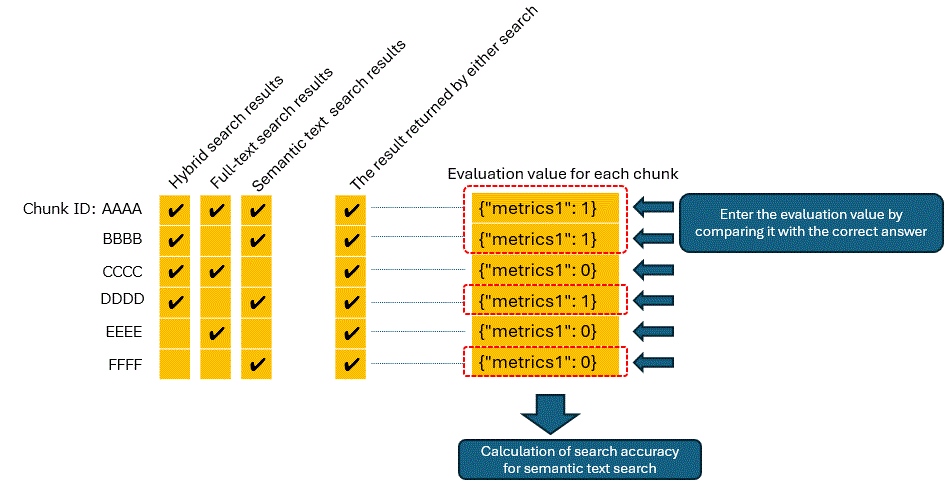
Based on the search accuracy of each subquery, you can tune the combination method of subqueries. Adjustable parameters include, for example, the weighting between full-text search and semantic text search, and the number of retrievals each subquery returns. If the semantic text search has a higher precision compared to full-text search, it is possible to increase the weight of semantic text search used in the final ranking calculation. Additionally, by setting the number of retrievals (num_results) in subqueries to a larger value than usual to obtain trace information, and calculating search accuracy such as recall and precision for each number of retrievals, recall@k, and precision@k, you can determine the appropriate number of retrievals from subqueries. As a result of evaluating search accuracy, you may detect issues that cannot be improved by the combination method. In such cases, tuning of both semantic text search and full-text search is performed.